Counting What Cannot Be Seen: Pressure-Testing Environmental Monitoring in UK Cell and Gene Therapy Cleanrooms
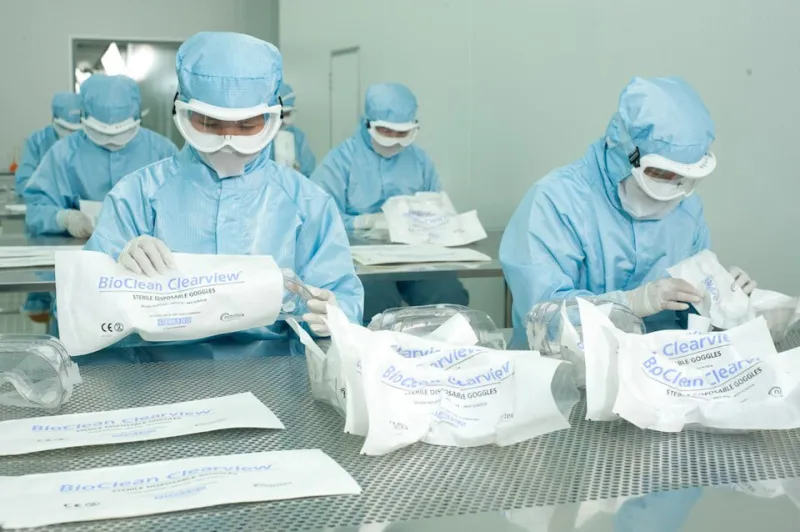
Photo: BioClean Cleanroom, CC BY 3.0, via Wikimedia Commons
Cell and gene therapy manufacture compresses into days what traditional sterile manufacturing spreads across weeks. Batches are small, sometimes single-patient; campaigns are short; product shelf life may be measured in hours before cryopreservation. The cleanroom, meanwhile, is asked to deliver the same assurance as a facility running a month-long campaign, with a fraction of the environmental data on which to base it.
That mismatch is the central quality problem in many UK advanced therapy facilities. Environmental monitoring plans are often carried over wholesale from conventional pharmaceutical operations, where they made sense for different batch structures and different volumes of evidence. The result is a programme that generates plenty of plates but comparatively little usable assurance.
What follows is a framework for pressure-testing an existing plan, set against UK GMP expectations as they stand in 2026.
The inherited plan and why it stops fitting
Conventional monitoring assumes continuity. Locations are fixed because the process is fixed; limits are derived from long historical datasets; trending works because hundreds of results accumulate in a campaign. Advanced therapy manufacture disrupts each of these assumptions. Layouts change as products move through development. Open manipulations cluster differently, with a small number of operators performing many interventions rather than many operators performing a few. And the result count per batch can be low enough that a single colony moves a trend line visibly.
Annex 1 of UK GMP, applied since 2022, sets the direction of travel: a documented contamination control strategy, a monitoring programme justified by risk assessment, defined alert and action limits, and investigation of excursions. It does not prescribe a universal sampling grid, and that is precisely where inherited plans tend to fall down — they are copied rather than argued.
The regulatory frame, briefly
Classification of cleanrooms follows ISO 14644-1, with monitoring guidance in ISO 14644-2; the older ISO 14698 standards for biocontamination control remain a useful reference for method detail. For grade A zones, the expectation is effectively no microbial growth, with any growth during critical operations investigated. Active air sampling volumes, settle plate exposure times and contact plate areas are conventional and well documented; what requires justification is where you sample, how often, and what you do with the organisms you recover. Tissue-based products bring the Human Tissue Authority into the picture alongside the MHRA, and the dual expectations should be reconciled in a single strategy document rather than two parallel ones.
Designing locations from the process, not a template
Begin with airflow visualisation. Smoke studies conducted under dynamic conditions, with the actual equipment in place and operators performing the actual interventions, should determine which surfaces and zones are critical. A monitoring location that looks sensible on a floor plan may sit in a dead zone, or may miss the point where an operator's gloved hand passes over an open container.
Sample locations should be justified individually, in writing, with reference to the specific risk they address: the critical zone during fill or manipulation, transfer hatches, the surfaces of equipment that enter grade A, the gowning corridor, and the points where first air meets potential contamination. When the layout changes — and in development facilities it will — the justification should be revisited rather than the old grid reinstated.
Methods: what each one really measures
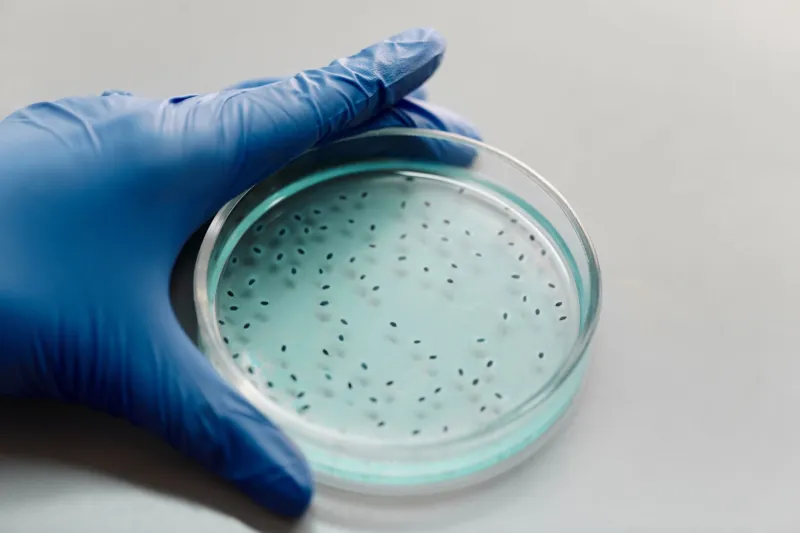
Settle plates capture what falls out of the air over time; they are inexpensive and useful for critical zones, but they are also crude aerobiological instruments, biased towards larger particles and constrained by desiccation over longer exposures. Active samplers give a defined volume and a comparable result in CFU per cubic metre, but the sampling head itself becomes a contamination risk if handling is poor, and the d50 cut-off of the instrument should be understood before results are compared over time. Surface monitoring by contact plate recovers organisms from flat, regular surfaces reasonably well; irregular geometry needs swabs, with lower and less consistent recovery acknowledged in the interpretation.
Media selection and incubation should be deliberate. A typical arrangement uses a general bacterial medium and a fungal medium, with incubation at around 20–25 °C for five to seven days for environmental isolates and 30–35 °C for two to three days for organisms of human origin. Growth promotion testing of each batch of media, against a defined panel including reference strains, is not optional. Organisms recovered from grade A or B should be identified to species where the result will influence action, because the difference between a coagulase-negative staphylococcus and a Gram-negative rod is the difference between an operator practice question and a water or drainage question.
The small-numbers problem
Statistical process control assumes enough data to estimate a distribution. Many advanced therapy programmes never reach that point. A control chart built on a dozen counts will show variation that is mostly noise, and acting on it produces churn rather than control.
A workable approach is to set alert limits from a combination of historical data, method capability and risk, and to review them at defined intervals rather than continuously. Normalise where possible — CFU per cubic metre rather than per sample, counts expressed per unit of exposure — so that results remain comparable as sampling volumes change. Treat any recovery in grade A as an investigation trigger irrespective of trend, and accept that for a period in a new facility, cumulative data across batches, not within them, is the trend.
Operators are the dominant variable
In a facility with a handful of trained staff and a large number of interventions, personnel monitoring carries more diagnostic weight than it often receives. Glove and gown sampling after critical operations, recorded alongside a log of who performed which intervention and when, lets you connect a monitoring result to a behaviour. Gowning qualification, periodic requalification, observed aseptic technique during interventions, and a limit on how many people occupy a grade B area are all part of the same control set. Without the intervention log, an excursion is an anecdote; with it, it is a finding.
Responding when the ledger shows growth
Response should be tiered and pre-agreed. A grade A recovery during critical operations triggers immediate investigation and a product impact assessment. A grade B exceedance prompts review of operator activity, cleaning and disinfection records, HVAC status and sampling technique. A rising trend of low-level counts in grade C or D may indicate a gowning or cleaning drift rather than a sudden failure.
Include the false positive route explicitly in the procedure. Sampling is a manual process involving lids, contact and handling; some recoveries are artefacts of technique. Investigating a contaminated settle plate as rigorously as a genuine breach, and documenting the conclusion either way, is a mark of a mature programme rather than a weak one.
A checklist for pressure-testing your own plan
- Is there a single, current contamination control strategy document that the monitoring plan visibly derives from?
- Were sampling locations justified against airflow visualisation, and re-justified after the last layout change?
- Does every sampling method have a written rationale, including its known limitations?
- Are alert and action limits defined, documented and reviewed at stated intervals?
- Is any grade A recovery treated as an investigation irrespective of count?
- Are media batches growth-promotion tested against a defined panel?
- Are recovered organisms identified to a level that supports the resulting action?
- Does an intervention log allow you to link results to operator activity and timing?
- Is trending method appropriate to the number of data points actually available?
- Are personnel monitoring results reviewed at the same forum as environmental data?
- Is there a documented, tiered response procedure, including product impact assessment?
- Is the false-positive pathway investigated and recorded rather than dismissed?
- Do records support data integrity expectations — plate identity, incubation, reader, audit trail?
- Are training and gowning qualification records current for everyone who entered the suite?
- Has the strategy been reviewed since the last change in product, process or personnel?
A monitoring programme is not a plate count. It is an argument, made in advance and tested continuously, about where contamination could come from and what would give early warning. In advanced therapy manufacture, where the batch is precious and the evidence base is thin, that argument has to be sharper than most.