The Bench Is Not the Villain: Why UK Lab Infection Control Needs Human Factors
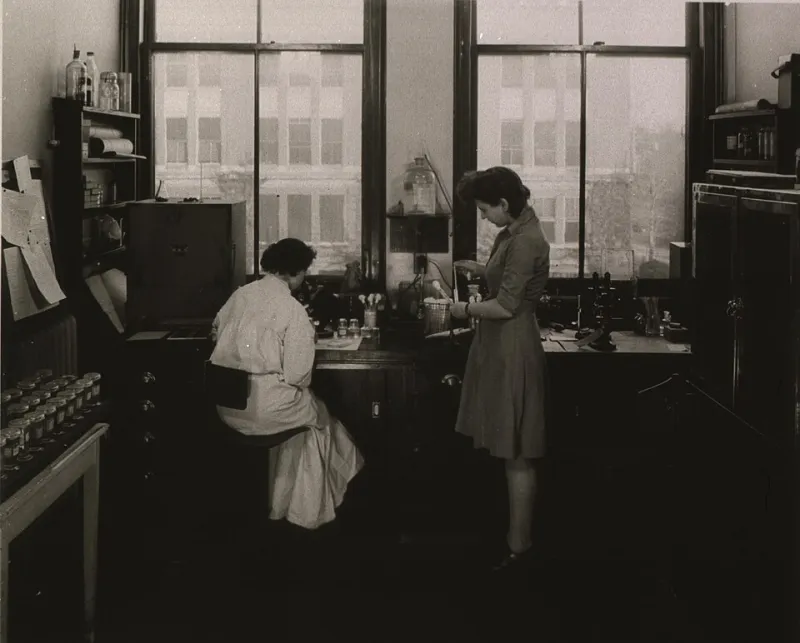
Photo: National Library of Medicine - History of Medicine, No restrictions, via Wikimedia Commons
Diagnostic laboratories are often described as controlled environments. In practice, they are workplaces shaped by deadlines, interruptions, shifting rotas and the quiet compromises that emerge when a busy bench has to accommodate too much work in too little space. When a contamination event or near-miss occurs, the reflex is to ask which instrument failed, which surface was missed or which standard operating procedure was not followed. Those questions matter. But they often arrive too late, and they can obscure the more useful question: why did the work make that error likely?
Contamination is often a workflow outcome
Consider a sample reception area during a winter surge. Samples arrive in batches, some leaking, some mislabelled, some requiring urgent processing. Consumables are stored wherever space allows. A technician working under time pressure reaches across a clean zone to retrieve a tip box. A colleague asks for an urgent result. The phone rings. None of these events is unusual. Together, they create the conditions for a breach.
This is not an argument against personal responsibility. It is an argument for realism. Human factors research in healthcare and high-reliability industries has long shown that error is strongly influenced by system design: the layout of equipment, the clarity of tasks, the availability of resources and the cognitive load on staff. Laboratories are no exception. If a bench is cluttered, if clean and dirty flows cross, or if staff must remember several subtly different protocols under pressure, the system is asking for trouble.
The audit illusion
Audits are essential to laboratory quality. They provide evidence of conformity, identify gaps and support accreditation under frameworks such as ISO 15189. But an audit is a sample of practice, not a complete picture of work-as-done. A tidy bench on the day of inspection does not prove that the bench is tidy at 2am during a backlog. A signed training record does not prove that a member of staff can apply a complex procedure when interrupted.
When audit becomes the dominant lens, it can create false reassurance. Teams learn to prepare for inspection rather than to redesign the work. Findings are closed with a new form, a refreshed poster or a reminder email. The underlying friction remains. The next near-miss is then attributed to individual carelessness, when it may be the predictable output of a poorly designed process.
Design the bench around the work
Human factors is sometimes mistaken for a soft concern about attitudes. In a laboratory, it is intensely practical. Bench layout should follow the sequence of work, not the shape of the room. Clean and dirty zones should be physically distinct and obvious to someone who is new to the shift. Consumables should be placed where they are needed, in the order they are used, so that staff do not have to cross contamination boundaries to retrieve them.
Closed-system processing and automation can reduce the number of open steps where contamination may occur. Where full automation is not feasible, smaller interventions can still help: dedicated waste routes, colour-coded containers, clear visual controls, and standardised layouts across benches so that staff moving between rooms do not have to relearn the environment. These are not cosmetic changes. They reduce reliance on memory and lower the cognitive burden of routine work.
Training that reflects the real shift
Training often focuses on knowledge rather than performance. Staff can recite the procedure but may not have practised it under realistic conditions. A more useful approach is scenario-based training that includes interruptions, handover, equipment failure and time pressure. Competency assessment should observe the task as it is actually performed, not only the tidy version described in the standard operating procedure.
This matters for infection control because many breaches occur at transitions: between sample receipt and processing, between shifts, between staff groups, or between routine and urgent work. Training should explicitly cover those transitions. It should also give staff permission to stop, question and escalate when the workflow feels unsafe. A laboratory that treats every interruption as a failure of concentration, rather than a design issue, will keep producing the same near-misses.
Handovers and staffing pressure
Handover is a well-recognised risk point in clinical care, and it deserves the same attention in the laboratory. A rushed handover can lose critical context: which samples are pending, which equipment is out of action, which area has been decontaminated and which requires further attention. Staffing pressure compounds the problem. Agency staff, vacancies and unpredictable workloads can mean that the people most familiar with a bench are not the people working on it.
Practical fixes include structured handover sheets, visual status boards, short stand-up briefings at shift change and clear ownership of unresolved issues. These tools are simple, but they only work if they are built into the shift rather than added as another administrative task. The same principle applies to interruption management: designated urgent channels, do-not-disturb periods for critical steps, and visible cues that signal when a bench is in a high-risk phase of work.
From scorecard to learning system
None of this means abandoning audit. It means using audit differently. Instead of asking only whether staff complied, auditors should ask whether the workflow made compliance easy or difficult. Near-miss reporting should be treated as valuable data, not as an admission of failure. A just culture does not ignore accountability, but it recognises that punishing individuals for system-induced error discourages the reporting that prevention depends on.
For UK diagnostic laboratories, the case for human factors is practical. Contamination and near-miss events are rarely caused by a single careless moment. They emerge from the interaction between people, tasks, equipment and environment. Audit culture without workflow redesign can create the appearance of control while leaving the underlying risks intact. The bench is not the villain. The better question is whether the system around it has been designed for the people who have to use it.