Before the Ward Alert: A Candida auris Playbook for UK Microbiology Laboratories
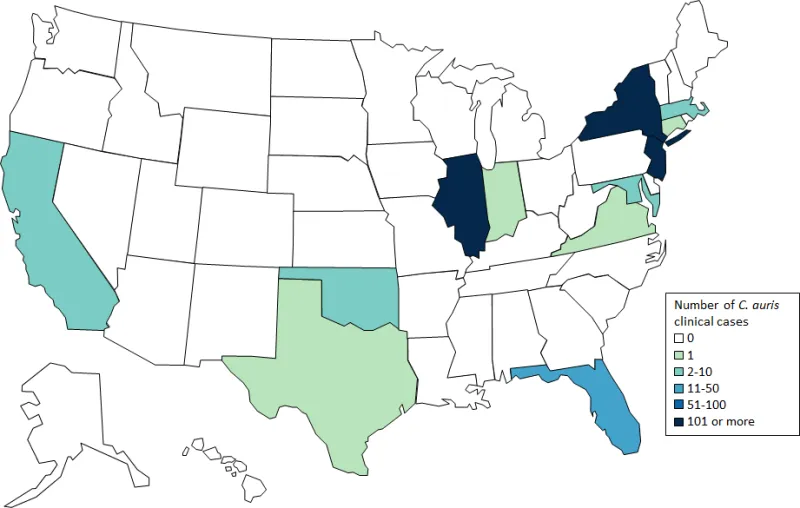
Photo: Centers for Disease Control and Prevention, National Center for Emerging and Zoonotic Infectious Diseases (NCEZID), Division of Foodborne, Waterborne, and Environmental Diseases (DFWED), Public domain, via Wikimedia Commons
Candida auris is not a new organism, and it is not a reason for alarmism. It is a reason for preparation. The yeast can colonise patients without causing symptoms, persist in healthcare environments and prove difficult to identify reliably in some routine workflows. For UK clinical microbiology laboratories, the sensible question in 2026 is not whether a dedicated playbook is desirable. It is whether the laboratory can afford to wait until the next ward alert to write one.
The opinion here is straightforward: Candida auris preparedness should be built before the outbreak conversation begins. A playbook written during an incident tends to be a hurried collection of email instructions, half-agreed referral routes and unresolved questions about who does what. A playbook written beforehand can be tested, criticised and improved while there is still time to do so.
Why the bench needs a playbook now
Candida auris has already prompted public health attention in the UK and internationally because of its potential for colonisation, environmental persistence and healthcare-associated transmission. National guidance and UKHSA advice provide an important framework. But guidance does not automatically translate into a bench-level workflow that works at 2am, with a partial identification result and a ward team asking for an answer.
That gap is where a laboratory playbook earns its place. It should not duplicate national guidance. It should translate it into local decisions: which specimens are screened, how isolates are identified, when confirmation is sought, how results are communicated and who coordinates environmental sampling requests.
Identification without false comfort
Candida auris can be misidentified by some biochemical and commercial systems, and laboratories should not assume that every identification pathway is equally reliable. The playbook should set out a local algorithm: what happens when an isolate is suspected, which method is used first, when molecular or reference laboratory confirmation is required and how presumptive results are reported.
This is not about distrusting routine methods. It is about recognising their limits. A laboratory that knows where its identification workflow is strong, and where it needs confirmation, is better placed to give infection prevention teams a useful answer without overstating certainty. Antifungal susceptibility testing and referral pathways should be included in the same algorithm, not left as an afterthought.
Environmental sampling: a disciplined ask
During an incident, infection prevention and control teams may ask the laboratory to support environmental sampling. The playbook should agree, in advance, what that support looks like. Who collects swabs? Which surfaces are prioritised? What transport conditions apply? Which method is used for culture? How are results interpreted and reported?
Environmental sampling is not a substitute for cleaning, hand hygiene and other core controls. Nor is a negative swab a guarantee that transmission has stopped. A disciplined approach is more useful than a large number of poorly targeted samples. The laboratory should be clear about what it can and cannot conclude from the results it provides.
Communication with infection prevention teams
Candida auris communication needs a named route. The playbook should identify who in the laboratory speaks to infection prevention and control, who authorises urgent communications out of hours and how presumptive, confirmed and resolved results are described. It should also distinguish colonisation from infection in plain language, because ambiguous wording creates unnecessary anxiety or false reassurance.
Good communication is not simply fast communication. It is consistent, documented and proportionate. A short agreed statement of what is known and what is pending is often more useful than a premature definitive message.
The gap between guidance and bench reality
National guidance often assumes capacity that a busy laboratory may not have on the day: molecular confirmation on site, rapid referral, sufficient staff to triage extra samples and a clear line to specialist advice. A playbook should acknowledge those constraints rather than pretend they do not exist.
That means practical detail. What happens out of hours? Which samples are prioritised? Where are suspected isolates stored? What is the escalation route if the reference laboratory turnaround is longer than expected? Who trains new staff on the algorithm? A playbook that ignores workload and staffing realities will be quietly abandoned when pressure rises.
What the playbook should contain
- A clear scope and local case definitions for screening and investigation.
- An identification algorithm with defined confirmation and referral points.
- Antifungal susceptibility and reporting arrangements.
- A pre-agreed environmental sampling framework with IPC colleagues.
- Named communication routes for urgent, out-of-hours and routine results.
- Stock, storage and transport requirements for relevant consumables and isolates.
- Training and competency requirements for laboratory staff.
- Audit and review dates, with version control.
Tabletop exercises are also worth the time. A short scenario discussion with microbiology, IPC and ward representatives can expose assumptions that a written SOP alone will not reveal.
A Candida auris playbook is not a prediction of disaster. It is a mark of a laboratory that takes surveillance seriously enough to prepare for the ordinary problems that accompany an extraordinary organism. The best time to build it is before the ward alert, not after.