The Hatch With a Job to Do: Assuring Pass Box Containment Before the First Transfer
Photo: Alex Rio Brazil, CC BY-SA 3.0, via Wikimedia Commons
Pass boxes occupy an awkward place in the containment laboratory. They are bought as equipment, installed as building fabric and used as furniture. Yet the moment a plate, a tube or a waste bag crosses the boundary between a containment Level 3 (CL3) room and a corridor, the pass box is the only engineered interface standing between two pressure regimes. If it has not been commissioned as a containment control, it is merely a hatch with a light on it.
What the specification actually claims
Manufacturers describe pass boxes with a familiar vocabulary: interlocked doors, HEPA filtration, nominal pressure differentials and alarm contacts. Those words describe a design intent, not a validated performance. The laboratory's task is to convert the former into the latter, on site, with evidence that can be shown to an inspector, an estates team or a future auditor.
That distinction matters because pass boxes are frequently treated as ancillary items. They may be omitted from the containment validation schedule, left out of change control when room pressures are adjusted, or handed to estates as a door with a service contract. In each case, the same assumption appears: that the hatch is passive. It is not. It has a containment function, and that function can fail quietly.
Interlocks: test the sequence, not the light
An interlock is a logic claim. The indicator lamp proves that the circuit has power; it does not prove that the opposite door is physically prevented from opening when the first is ajar. Commissioning should therefore test the sequence under realistic conditions, not simply confirm that the lamp changes colour.
The functional test matrix should include the normal opening cycle, attempted simultaneous opening, attempted opening with a trolley or gloved hand in the aperture, power interruption, manual override where fitted, and recovery after the fault is cleared. Each test should record the observed state of both doors, the alarm state and the time taken to restore normal operation. Where the interlock interfaces with a building management system, the test should confirm that the signal is received and acted upon, not merely transmitted.
A common weakness is the override. Some pass boxes provide a key-operated bypass for maintenance or emergency use. That bypass is legitimate only if its use is controlled, logged and followed by a documented return to service. An override that is never tested is an unknown state; an override that is never controlled is a permanent hole.
Pressure differentials and the myth of the neutral box
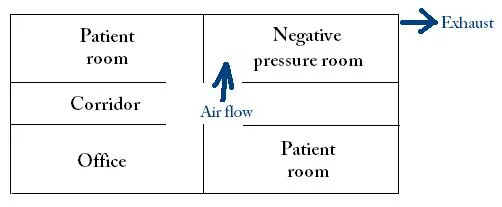
Pass boxes are sometimes described as neutral. In a containment laboratory, neutral is rarely a useful claim. What matters is the direction of leakage under the conditions in which the box is actually used. A box that reads negative relative to the corridor may still be positive relative to the room if the room pressure is more negative than the box.
Commissioning should therefore measure differential pressure at defined states: doors closed, transfer door open, room door open, and after a sequence of transfers. The measurements should be taken with a calibrated instrument and recorded alongside the room pressures at the time. The acceptance criteria should be written in advance and should state which side of the box is intended to be protective.
This is also where change control earns its keep. A pass box validated against a room at minus 30 pascals may not perform as intended after the room is rebalanced to minus 50 pascals. The box has not changed; its context has. Routine monitoring should therefore compare the pass box reading with the current room reading, not with a historical value that no longer describes the space.
Airflow disturbance at the transfer moment
The transfer itself is the event that matters. Opening a door disturbs the air at the interface, and the pass box extract must recover quickly enough to restore the intended flow. A smoke pencil or airflow visualisation test at the door line can show whether the box is capturing air as intended or whether the opening action is pushing a plume into the room or corridor.
Visualisation should be done with the box empty and with a representative load, because a full box changes the internal flow pattern. It should also be repeated after filter changes, fan adjustments or any alteration to the room's ventilation. The resulting records are not decorative; they are the evidence that the containment claim survives the moment of use.
Alarms that nobody can hear
An alarm is only a control if someone responds to it. Commissioning should establish who receives the alarm, how quickly, and what they are expected to do. A local buzzer in an unattended corridor at night is not an alarm system; it is a sound. Where the pass box is connected to a building management system or a monitoring service, the test should confirm the route, the delay and the escalation path.
Alarm setpoints should be justified and documented. Sensor drift should be checked against a reference instrument, and the mute function, if fitted, should be time-limited and logged. The fail-safe state should be known: does the interlock default to locked, unlocked or indeterminate on power loss? The answer should be written in the local rules and tested during commissioning.
A commissioning checklist that produces evidence
A practical commissioning pack for a containment pass box should include:
- a design review against the user requirement specification and the local risk assessment;
- factory acceptance documentation, including filter integrity and fan performance;
- site installation checks for seals, frame, services, gauges and access for maintenance;
- an interlock functional test matrix covering normal use, fault conditions and override;
- differential pressure measurements at defined door states, referenced to current room pressures;
- airflow visualisation at the interface with a representative load;
- alarm and building management system integration tests, including out-of-hours routing;
- recovery checks after door cycles and after a simulated power interruption;
- compatibility with the intended decontamination method;
- training records and a signed local rule for use and override.
Each item should have an acceptance criterion and a named signatory. The output is not a folder of certificates; it is a defensible statement that the hatch performs as a containment control.
Routine monitoring between validations
Routine monitoring should be proportionate but real. Daily checks can confirm that the interlock operates, the pressure indication is within the expected range and there is no visible damage to seals. Periodic checks should compare the pass box reading with the room reading, test the alarm route and inspect filters and fans. Annual validation should revisit the full test matrix, particularly if the room has been rebalanced or the box has been repaired.
Trending matters. A slowly declining pressure differential or an increasing door-closure time may be the first sign of a failing seal or fan. A pass box is not a fire door; it does not improve with age, and it should not be left to declare its own fitness.
Governance: who owns the hatch?
The final question is ownership. Pass boxes sit between laboratory practice and estates engineering, and that boundary is where responsibility can evaporate. The local rules should name the owner, the maintenance route and the change-control trigger. Any alteration to room pressure, ventilation, filter type or interlock logic should prompt a review of the pass box validation.
When that governance is in place, the pass box stops being a hatch with a job to do and becomes what it was specified to be: a verified containment interface, carrying evidence as well as materials across the boundary.