Sealed, Not Assumed: A Joint Lab and Estates Protocol for Negative-Pressure Isolation Rooms
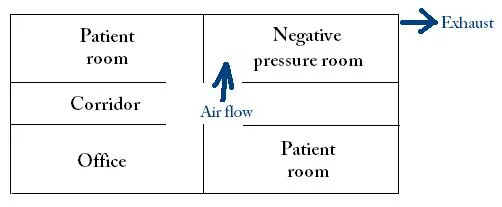
Photo: Difu Wu, Public domain, via Wikimedia Commons
The assumption problem
A negative-pressure isolation room is easy to describe and harder to sustain. The door closes, the extract fan runs, the room register says it is available, and the clinical team reasonably assumes that airborne transmission risk is being managed. That assumption is doing a great deal of work. It rests on filters, seals, dampers, fan belts, control sensors, door closers and the willingness of busy staff to keep doors shut.
For UK microbiology and estates teams, the question is not whether negative-pressure rooms exist on a floor plan. It is whether each room is performing as intended at the point of use, and whether that performance has been verified in a way that stands up to scrutiny when respiratory pressures rise during winter 2026/27.
Validation should therefore be treated as a shared responsibility. Laboratories can advise on sampling and interpretation; estates can confirm engineering performance; infection prevention and control can confirm clinical fitness for purpose. No single group can sign off the room alone.
What negative pressure does—and does not—mean
The purpose of a negative-pressure room is directional airflow. Air should move from cleaner or lower-risk adjacent spaces into the room, then be extracted and, where required, filtered before discharge. The pressure differential is a visible proxy for that direction, but it is not the whole system.
A gauge reading of negative pressure does not, by itself, prove adequate air changes, correct filtration, effective sealing or appropriate room use. Nor does a single air sample prove that a room is safe. Viable air sampling is a snapshot: it is influenced by sampler location, duration, flow rate, culture method, occupant activity and the timing of sampling relative to procedures that generate aerosols.
This matters because borderline results are often over-interpreted. A low pressure reading may reflect a door left ajar, a drifting sensor, a blocked filter or a genuine extract fault. An air sample that grows nothing may be reassuring, but it is not a certificate of absence. The correct response is to interpret the evidence as a set, not as isolated numbers.
Before occupancy: a practical checklist
A pre-occupancy check should be proportionate, documented and repeatable. The following framework is suitable for a joint lab-estates review before a room is returned to service or ahead of seasonal demand.
- Confirm the room’s intended clinical use and the required pressure regime against local specification and current NHS estates guidance, including HTM 03-01 principles where applicable.
- Verify the pressure differential at the door with the room closed and in its normal operating state. Record the value, the instrument used, the date, the operator and any recent maintenance.
- Check the direction of airflow at the door using a smoke pencil or equivalent method. Do not rely on the gauge alone.
- Confirm air-change performance through the established estates validation route. Record the method and result; do not infer air changes from fan speed or room volume.
- Inspect door seals, self-closers, pass-through hatches and service penetrations. A well-tuned fan cannot compensate for an open path.
- Confirm extract and supply balance, filter condition and alarm function. Ensure that alarms report to a monitored location, not merely a local panel.
- Review the pressure trend over several days, not only a single instant reading. Short-term fluctuations can reveal doors left open, control instability or intermittent faults.
- Where air sampling is used, define its purpose in advance. It may support investigation or commissioning, but it should not replace engineering verification.
- Agree the room’s operational rules with ward staff: door discipline, permitted occupancy, cleaning and maintenance access, and the route for reporting faults.
- Record a clear decision: fit for use, fit with restrictions, or out of service. Include the date for recheck.
Reading borderline results in a winter context
Winter 2026/27 will bring familiar pressures: higher occupancy, more respiratory admissions, staff turnover and estates teams juggling maintenance backlogs. In that environment, borderline results deserve a defined response rather than a verbal reassurance.
A pressure differential that sits just inside the target range but fluctuates should trigger a trend review and a door-discipline check. A room that passes when empty but loses pressure when occupied warrants investigation of door use, equipment placement and supply-extract balance. An air sample that is difficult to interpret should be considered alongside the engineering record, the sampling method and the clinical scenario.
Laboratories should resist the temptation to issue a broad “clear” result from a single sample. Equally, estates teams should not treat a gauge reading as a complete validation. The strongest position is a short, signed record that states what was measured, how, when and by whom, and what remains uncertain.
A shared sign-off, not a ritual
The room that breathes is not a room that has been declared negative once. It is a room whose airflow, controls and human use are checked together, at a frequency that matches its clinical importance.
For UK teams, the practical step is to agree a joint validation record before the next respiratory season. It need not be elaborate. It must be honest about the limits of each test, clear about who owns each action, and robust enough to show that negative pressure was verified—not merely assumed.